The night sky at Big Bend National Park inspires awe and imagination.
Sometimes here at Big Bend National Park I look up at the night sky, at the thousands of stars that I can see and the trillions and trillions that I cannot, and I think, “There’s someone out there somewhere for me. And she, or it, probably has three heads, one giant eye, seven arms, and isn’t human, but still. She/it is out there and we could be together someday.” So you see, even if you’re single at age 46, there is still hope among the stars, and boy does Big Bend National Park have stars.
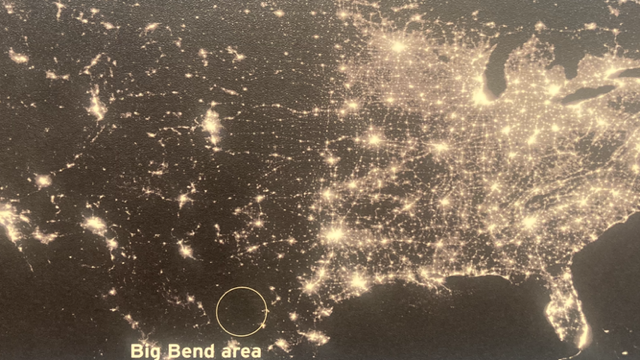
Big Bend is officially an International Dark Sky Park (and one of the darkest places in the contiguous states) recognized as such by DarkSky International, which sounds like a top secret organization but really is just a group that advocates for more common sense lighting in cities so that we can see our own Milky Way galaxy and feel awe rather than rage, rage against the blinding of the street lights.
The solution to light pollution, it turns out, isn’t that difficult. Lights should, for example, face downward, and they should be of a certain wavelength—not the wavelength of today’s vehicle headlights, which you might mistake as someone having their brights on during evening driving only to flash them in anger and have them flash you back with even brighter headlights, thus simultaneously inflicting upon you guilt for your wrong (but reasonable) assumption as well as permanently damaged retinas, until after so many wrong assumptions you find the solution is in fact to drive at night with your left eye closed when facing oncoming highway traffic in the evening.
City light pollution of similar wavelengths also confuses and disrupts wildlife and since humans are animals, is it any wonder that it might confuse and disrupt our lives as well? Does chaos not most often come in the night?
Home in Minneapolis, I will go months without looking up at the night sky, because why bother? If you can see stars, it might be just a handful, strewn like a few scattered dice in a game of Yahtzee you’re bound to lose. It is only when I’m away from cities—when I’m camping—that I remember that I live not in a city, but on a planet, and not on a planet, but in a galaxy, and not in a galaxy but in a universe that is either infinite, or in any case, a universe that lays bare the finite capacity of the human mind for truly understanding the concept of infinity.
Similar thoughts as these no doubt led Flagstaff, Arizona, to make the necessary lighting changes to become the world’s first International Dark Sky City in 2001, work that started decades earlier leading it to also become a haven for astronomy today, and probably to have a citizenry with more vivid imaginations and frequent experiences of awe. Because did you know that there are more stars in the universe than grains of sand on our planet? Of all the beaches and all the dunes and deserts on earth, the literal oceans of sand—just mountains of the stuff—those grains are outnumbered. And that’s how I know my lady/thing/it is out there, somewhere. Because the odds are just astronomical that my seven-armed Sheclopsborg isn’t out there somewhere waiting to wrap her tentacles around me. Also, Jupiter and Saturn each have around 80 moons.
I learned all this because last night I went to a park ranger event about the night skies (and then did some Googling), and though I was promised a peek through a telescope, the ranger had come equipped with only binoculars, and so I left early to drink wine at my campsite and look at the stars on my own. And to notice that late in the evening among the campsites, well after the sun sets, you can see levitating lights bobbing along in the darkness, your fellow campers equipped with stars of their own, the latest headlamp styles on their evening bedtime bathroom reconnaissance. These are the hearty tent campers, those without sinks and toilets, as well as those who may want to limit the use of their own camper facilities—if your toilet (black water tank) or gray water tanks fill up, you’ll need to hook up and drive out to dump them at the campground dump station. It’s not a huge hassle, but it’s easier to do this once, upon departure.
Yesterday I had to move sites because the same site wasn’t available for two consecutive weeks, so I got fresh water and dumped the tanks and talked to a park ranger while I was doing it, who mentioned the University of Minnesota (where I work) football team had a star running back years ago whose name he couldn’t recall. I said “Was it Tiki Barber?” and he said “Yeah, that’s it.” But it wasn’t Tiki, I found out later; it was Marion Barber, no relation. Still, it’s somewhat of a miracle I was able to recall half the right name, because I know nothing about football.
Today I hiked 5 miles up a mountain and back down on the Lost Mine Trail, and it was beautiful, and I was closer to the stars than I’ve been in a long, long while.







Leave a comment