I finished Steinbeck’s Travels with Charley last night. I hadn’t read it in more than a decade, and it’s not as insightful as I recall thinking it was the first time around. Presumably, this means I’ve learned more since then, but it’s curious to me how a book can have so much meaning at one point in your life, and so much less at another (to be clear, it’s still a very good book). I remember reading Still Life with Woodpecker about 20 years ago, and I felt like it really spoke to me at the time. Then, re-reading it 7 or 8 years ago, it seemed almost meaningless.
At the end of Steinbeck’s book, he visits New Orleans after briefly touring the South. He’s been apprehensive about this part of his journey. The year is 1960: several years before MLK’s March on Washington, but fully 6 years after Brown vs the Board of Education desegregated schools. Steinbeck watches in New Orleans as four little girls are being escorted by law enforcement into newly desegregated schools, while each day a mob of white people gathers to scream racial slurs at the children. Steinbeck talks about a little Black girl, Ruby Bridges, six years old, tiny and scared.
Steinbeck would often pick up hitchhikers, and near New Orleans, and again and again they’d complain about “n**gers.” It made him sick and he ended his journey shortly thereafter. It blows my mind that these things occurred so recently. That some of the people Steinbeck encountered may still be alive. And that even if they aren’t, then their children, and their children’s children, are likely to carry on some element of that prejudice.
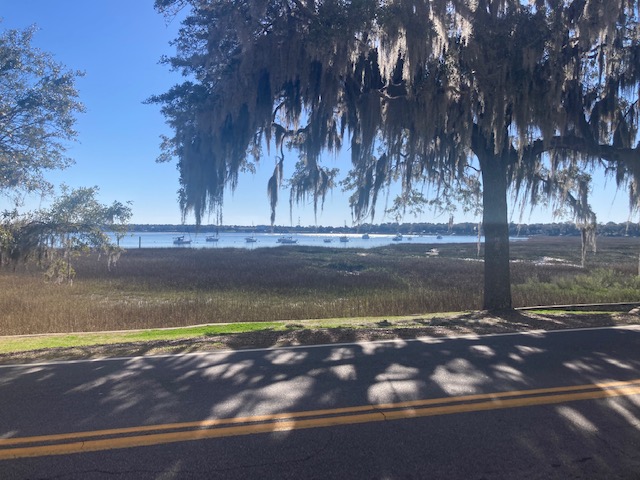
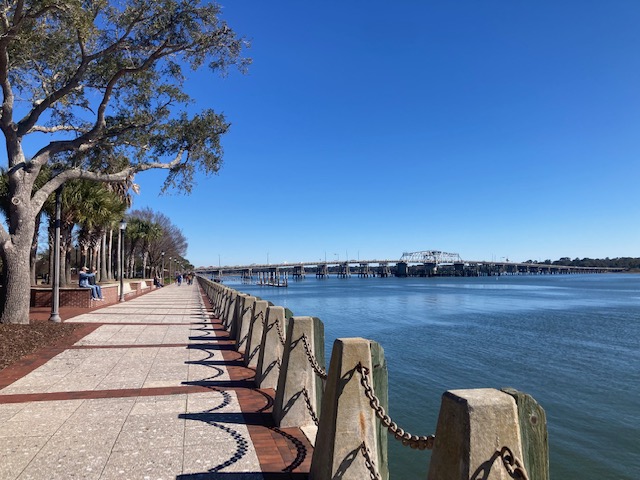
Today I drove into Beaufort, the “most romantic city in South Carolina.” A small fishing town with a lot of history, people arrived in Beaufort in 1514, and the town was founded officially in 1711. There’s a large Gullah population here, which is just a fascinating culture. I once saw Queen Quet of the Gullah/Geechee Nation speak at the U of Minnesota about her culture and people.
Beaufort was one of the first towns occupied by the Union army in 1861. Wealthy plantation owners fled and left behind 10,000 slaves, years before the Emancipation Proclamation would “officially” set them free. The former slaves, a sudden majority in Beaufort as the local whites fled, ran the town gov’t until Jim Crow laws decades later once again minimized the power of Black people in America. It’s just a monstrous history, and it’s laughable to think its repercussions are “all in the past.” There’s no such thing as all in the past. The present is built on the past, so by necessity the past is present, diminished perhaps, but never gone.
Last evening I drove to a restaurant a few miles away. I pulled up to the bar and a couple came in and sat next to me. The man was a retired fire chief. In the late 90s he lived on a 42 foot boat in New Jersey, where he is from, so he could relate to camper life, he said. He and his wife had recently retired nearby. We talked fishing, and camping, and everyone was talking about the Alex Murdaugh trial happening not far from here. I was having a great time chatting with this couple, and then the firefighter brought up how he thought our secretary of transportation was doing a terrible job because a train had crashed in Ohio, and he maligned the secretary because he is gay. I paid my tab and left. Before I did, the bartender gave me a cutting of a small cactus on the bar that I’d complimented, and I’m going to try to get it growing in my camper.
It was cool today, mid-50s, with mid-40s overnight. 70 tomorrow. I skipped fishing today, but I’ll try again soon.










Leave a reply to cfmusg78 Cancel reply