
The part of my trip where I half planned out where I was going has seemingly come to an end and I’m basically winging it week to week at this point. I’m surprised it lasted as long as it did—I’m just not much of a planner.
After a week in southern Joshua Tree I’ve moved to the northern half, what the locals and regulars call “topside.” I’m now camping just outside Joshua Tree National Park on BLM (bureau of land management) land. It’s not much to look at—essentially mud flats—but it’s free and just a few miles from the park, and since most of the campgrounds in the park don’t have water or electric anyway, you’re really getting your money’s worth from the BLM. Not only that, but with the sun so plentiful here, if you have solar the electricity is free, limited only by your solar panel capacity. About half of the homes around here seem to have some solar, many with their entire roofs covered, generating thousands of watts of power. And why not, with the frequency and intensity of the sun in southern California, it pays for itself in short order. Which is good because gas here is $4.50 a gallon and food is expensive, so a little free camping feels good on my thinning wallet.
There are probably 100 other campers out here on perhaps 100 acres of BLM land, some of them camping and others seemingly living here. BLM land is notoriously lax when it comes to rule enforcement. You’re generally supposed to stay only a couple weeks, but then if you move a hundred feet, you’re probably good for another two weeks. Or just stay put—no one seems to be around to care or enforce anything.
BLM is the largest manager of federal public lands in the nation followed by the U.S. Forest Service, and on both you can often camp for free. Same with Bureau of Land Reclamation and Army Corps of Engineers land. It’s not inconceivable to think you could camp for free or close to it in America for your entire life if you really want to, but generally I like to be nearer to other campers just for the potential conversation.
A few days ago I struck up a chat with a park police officer, Megan, who was out walking her dogs Charlie and Lucy on her day off. Later she brought beers to my campsite and told me some fantastic stories. She has a degree in outdoor recreation and has worked as a firefighter, EMT, and park cop in Zion NP, on the Big Island in Hawaii, in Glacier NP, and now Joshua Tree, but after more than two years of being a park cop, she’s decided to go back to school for nursing in Salt Lake City, where she can be closer to her toddler niece and nephew.
Not long ago Megan “rescued” a bunch of guys having a bachelor party at Joshua Tree who’d gotten stuck on a relatively small boulder which they’d managed to climb up just fine, but after the psychedelic mushrooms kicked in, they couldn’t get down and so Megan, a mountain climber, had to bring each of them down by rope, where they then ransacked her backpack and gear for snacks and began to wander away before she corralled them with $150 fines. A not insignificant amount of her work, it turns out, is rescuing people who are on drug-induced spiritual quests gone wrong (the rest of it seems to involve southern California biker gangs).
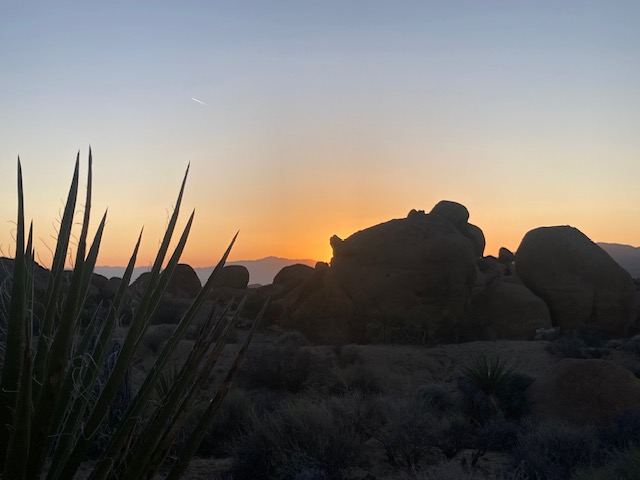
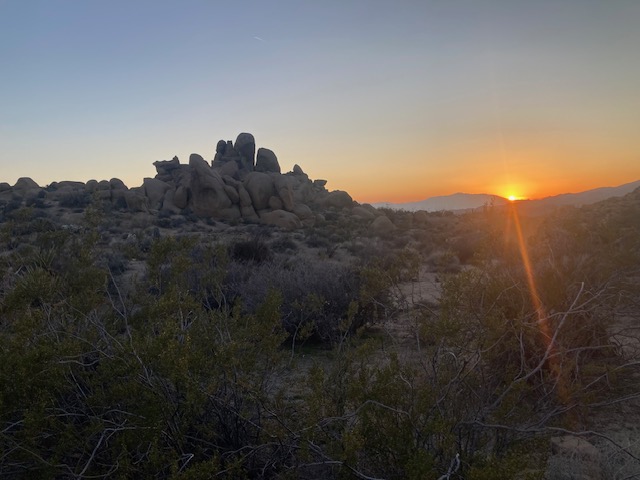
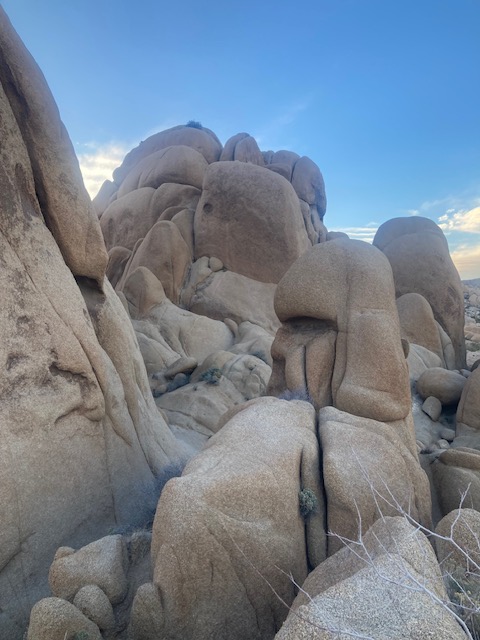
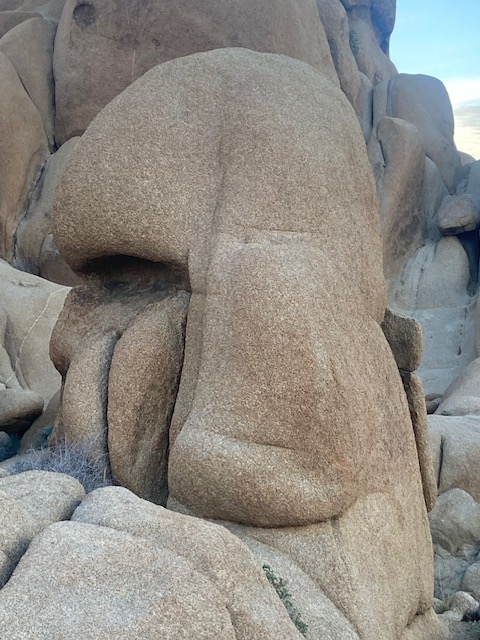
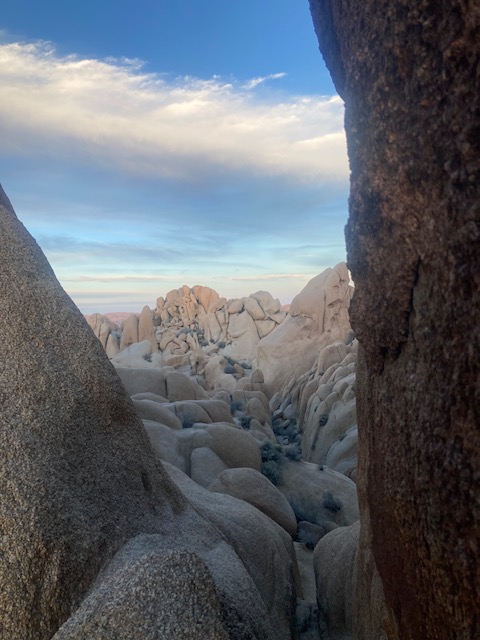
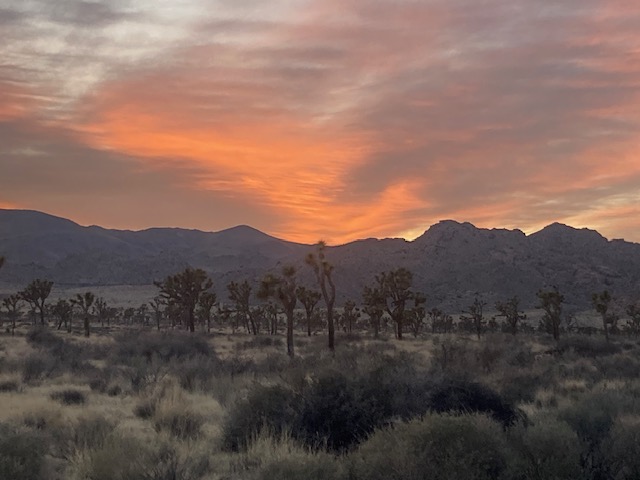
And you can see why, with the strange shapes of the desert, the Dr. Suess Joshua trees themselves, all gesticulating arms and crooked elbows contrasted by giant boulders weathered and rounded from millions of years of wind and rain after being sent forth to the earth’s surface through tectonic upheavals and volcanic activity. When the sun begins to set, strange shadows grace the land. There’s an energy here people seek to tap into and internalize, but it’s rarely as easy as eating dried fungus. Still, in my experience, the fungus is worth a shot, especially if Megan is around to help you down.
Pro tip: As it turns out, there are no Joshua trees in the southern half of the park. The trees live in altitudes of roughly 2,000-7,000 feet, a little cooler and higher than the south offers. Megan also let me know they aren’t technically trees, but plants in the yucca family.
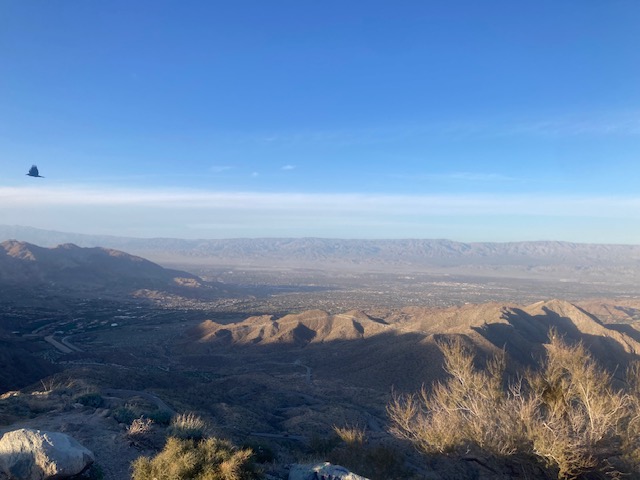
I stopped by Palm Springs for a few hours on Sunday, then drove through the San Bernardino mountains, nearly up to the snow line. Three hours in a city and I was ready for countryside again. A topic worth a write at another time.







Leave a reply to cfmusg78 Cancel reply