Tragedy had struck at the campground, or, at least what passes for tragedy when not much is happening.
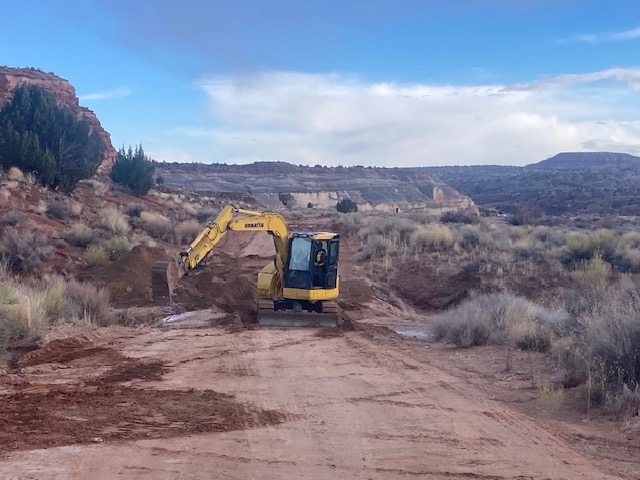
The dirt and gravel road to the small BLM campground I’m staying at on the border of southern Utah and Arizona washed out last night. A woman at the campsite next to me tried to leave in her Toyota Tacoma. She came back. Soon a hubbub at the campground had coalesced. Those of the half dozen of us camping here in the eight or so campsites, having previously not spoken to each other, now gathered round. Tragedy had struck, or, at least what passes for tragedy when not much is happening.
We banded together and told tales as travelers and humans are wont to do. The woman had called the nearby Paria Canyon Contact Station hoping to leave today, she said, and was asked what she would like them to do about it. “You are in the wilderness, what do you expect?” she was asked. Except that this campground has actual sites and pit toilets, plus charges a small fee, so she told him she expected roads, which seemed a fine expectation to me.
I woke up yesterday to the mountains in the distance topped with snow, a beautiful sight as the foothills and buttes in the foreground still held their reds and oranges and purples (their vermilions, if you will, here in Vermilion Cliffs National Monument). It made me want to live by mountains, a far off harbinger of weather—an early indicator each year that winter will soon come down from the peaks and descend into the lower elevation population areas. But this is late winter, a snowfall above 7,000 feet, sure, but here at 4,000 feet only the rain began, lasting all day and night.
In deserts there are what are known as washes—seemingly dry river beds that rapidly come alive when the rains fall and the dry and hardened ground, unable to absorb what it so desperately needs, allows the brunt of it to escape. And so it does, quickly, taking with it what it can, including, it seems, roadways. But losing the road is also a circumstance of this particular campground.
The other day a park ranger came through and asked me if I’d been hassling some construction workers who are building a road to this campground. It seems they were yelled at or threatened somehow, and perhaps I looked like the threatening type. And so these workers, they called the police and took the rest of the day off.
I said I’d seen nothing, then suggested to the park cop that perhaps they just wanted to take an early weekend and made it up. Who, after all, I said while wearing my Arby’s hoodie (less ironically so each day) and a newly minted mustache I’ve been working on for months as part of a just-departed beard, but which now menacingly rides alone on my face, hassles heavy equipment operators in the middle of the desert? He laughed and said maybe so, but they just want them to finish the damn road—they’ve been at it for too long, he said, which only supported my theory that the workers are lazy fools and should be told as much at every opportunity. After all, as they’re constructing the new road, they built a temporary one through a wash, so that each rainfall, it collapses. It is the most temporary of roads.
And so when I left last evening after work to drive into Page, Arizona, to get some dinner, gas, propane tank refills for heat, and other supplies, including some beer, part of the road was already collapsing. It was just wide enough for my truck, so I drove through and hoped for the best. The drop into the wash was three feet at most, and so catastrophe would be minor, a tow truck, most likely. But coming home, several more feet of the road had fallen into the wash, and it was now wide enough only for half of the truck. Which was a problem, as I needed both halves of the truck for it to operate effectively.
My options seemed to me limited, but I wanted a bed, so I ignored the more sensible of these options, put both halves of my truck into 4-wheel drive, and hit the gas with 30 feet of runway. Two tires I put deep into a water filled ditch and two I kept on the road as a wave rolled over my driver’s side windshield. But we (me and truck) made it, and soon we had beers. The next morning the rest of the road was gone.
But among our campground group of tragedy, a hero was born: a man had a shovel, and he had at that road, and would you know that underneath that temporary road was cobblestone, a finer road than the road placed upon it by the fools. After some digging, our hero drove down and through in his Nissan Armada. The Tacoma lady still wasn’t trying it, but I left not long after, too, hoping to find some hiking, but many roads were impassable, and so I was left to paved roadside attractions. In the evening, returning home, a park cop stopped me and said the road was closed for repairs. I told him my camper was down there, and he said they’d be done in a couple of hours.
We then talked about roads here, how they are slippery, almost like ice when they are wet, and like quicksand, too. Your feet or truck sink into this muck and when you pull up your shoes they want to stay put and bring with them two inches of new muddy tread. “It’s bentonite clay,” he said. His cop truck had huge knobby tires and rode a foot higher than mine, and even so they put square chains on the tires for emergency calls during rain. “It essentially turns them into tractor tires.”
Still, today down a road I’d hoped to travel for hiking trails, he said a van had slid from the road, and a jeep had tried to maneuver around it, then slid down the other side. The man in the van wouldn’t pay for an off-road tow truck, so he is still there. And now a man is out fixing this road, my road, probably making double time on the weekend for an emergency call. He drives a very nice, very new cherry red Range Rover. And he’s on the same crew that is building the new road, and I bet the money is very good indeed, and that he prays for rain often.






Leave a comment