Somehow the Lake Superior Circle Tour has been an official thing since the 1960s, but I didn’t know about it. There is, of course, an app, which is how you know things are real, but there’s also a yearly circle tour adventure guide (get it for $6), which not only includes suggested itineraries, but a page where you can collect 16 stamps from 16 stops along the way, then get a certificate proving you did the trip. And there are alternative tours, like the Java Tour with 12 coffee shop stops, or the Ale Trail featuring 20 breweries along the route.
I’m not a planner and not much for taking designated itineraries. In fact, I didn’t make any reservations for my trip, letting fate have its way with me because I am essentially lazy. But I thought I’d give the stamp collecting a try. Unfortunately, after collecting just two stamps, the visitor’s center for my third stamp was closed by the time I arrived. So to do the circle tour, at least the notarized kind where you get your coveted circle tour certificate of completion, you really need to have your times planned. I imagine that people who have regular stamp collections are likely the same people who are able to get all 16 circle tour stamps, because they have a lot of time.
After leaving Bay Furnace Campground in the UP, I headed toward the border crossing in Sault (pronounced “sioux”) Ste. Marie, a city split between Michigan (founded in 1668, it’s Michigan’s oldest city) and Ontario. It’s a little town with a big history in trade, and today it still has its famous Soo Locks, which lower ships on St. Marys River via gravity and water displacement so they can travel from Lake Superior to Lake Huron, Lake Erie, and through any other number of waterways. When I arrived they were lowering a 700 foot ship and visitors could watch the whole operation from a viewing area—a fun activity for little kids and old guys, if you have them. The city also has daily train tours of beautiful Agawa Canyon.
If you’re like me, you’re probably wondering why the St. Marys River doesn’t have an apostrophe. That is apparently because since 1890, the U.S. Board on Geographic Names (USGN) has discouraged the use of apostrophes in place names. How had we never noticed this before? While the USGN doesn’t offer any rationale, many suspect it’s because there’s no need to indicate possession for natural features, because ownership of nature and natural resources is an illusion and we are all temporal beings borrowing from one consciousness that through us experiences itself subjectively.
Which leads me to another thing: T-mobile’s (apostrophe required) website seemed to suggest I’d have cell service in Canada, but as soon as I crossed over, I lost it, which, beyond making even last minute planning impossible (like calling ahead 100 miles to see if there’s any availability at a campground), makes looking stuff up difficult. And I am a person who is constantly looking stuff up. What kind of tree is that? And that? Why are there so many kinds of trees? How many square miles is the UP? Why is the UP Michigan’s even though it makes no sense? Why are there so many shops selling “pasties” here? What is that ridiculously tall basketball player’s name in the John Wick series, the one with the ears? It will all just have to wait, because I’m in Canada now, on my way to Pancake Bay Provincial Park, Ontario, just 50 miles past the U.S./Canadian border.
In 2017, all provincial parks in Ontario stopped doing first-come, first-served camping, which makes camping hard for those of us who don’t plan. Lots of U.S. parks still have some FCFS sites set aside for those of us for whom adventure means “I don’t know where I’m going or what I’m doing.” Still, Pancake Bay has something like 400 camping spots sandwiched in a long stretch between Trans-Canada Hwy 17 and Superior, and though it was nearly full, I found one.
While the park is too close to the road for my taste, if you were to plan ahead, the spots right on the water are coveted and far enough from the road that the passing cars can’t be heard from the shoreline. There’s also some playgrounds for kids, and by my campsite, an outdoor fitness area had a pullup bar. Figuring I should get some exercise, I walked over and did two pullups, then lamented the fact that I’m so far gone that I can only do about two pullups. Whereas as a kid, I’d pop off 20, chin over the bar every time. Back then, the strength in the arms matched the weight of the body. But now, the weight of the body has become an anchor threatening to rip the arms from their very sockets, arms that are weak from hoisting only fish n’ chips, pasties, and beers above the chin.
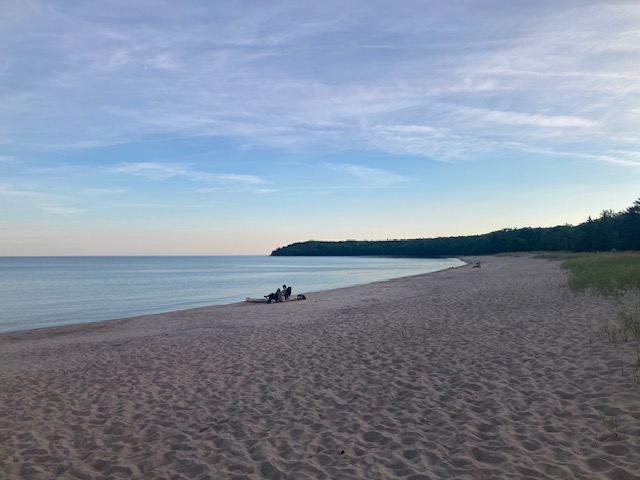
The bay from which the park gets its name is a sandy crescent several miles long, backed by a forest containing the campground with a view of the cool waters of Lake Superior for miles. If you just want a place to relax for a day or maybe two, and the weather is nice, this is a wonderful place to do it. Grab one of the sites nearest the water and you’ll feel like you’ve somehow cheated capitalism with a view you can’t afford on a property that would normally have someone whose job it is to ask you to leave or to set the dogs upon you. And the beach is so expansively large that it cannot be overrun, because the campground occupants are the primary goers, and so even 1,000 people on this beach means about one family every 50 feet.
The next morning, with no cell reception and nothing to buy, I left my phone and my wallet behind and walked to the beach in flip flops and swim trunks, with a folding chair, a book, and some sunblock in tow, because even the Canadian sun will burn me.
To leave your wallet or purse behind because you won’t be needing it, and your phone too, can be a wonderful experience. There’s nothing to buy here but firewood, and that in itself is incredibly freeing, to be unburdened from consumerism even for a day, from the easy Amazon delivery or the unnecessary runs to Target or Walmart or the gas station to buy a soda, just because. Here it’s not (at least nearby) an option, and that feels suddenly like the best of all possible options.
So I spent the entire day reading and relaxing on the beach, taking the occasional dip in the water, which was a little warmer because of the shallow bay. I’d slowly wade in, stopping every time I descended a few inches as the water rose past my calves, my knees, my fat thighs, then pausing excessively and slowing my descent as my nether regions began to retreat in anticipation. If you don’t have a platform to dive in from all at once, the torso is the hardest part of the body to make go under—it’s where all the heat is, the thing for which knit sweaters and puffy coats are designed, and naturally resistant to heat-thieving waters. And so with the torso, you must re-strategize, forcing it all at once into a dive.
In the evening, the thin wisps of clouds turn pink against the fading azure of the sky as the sun begins its retreat. I walk along the beach and see evidence of the day’s many activities. An abandoned game of hopscotch that will go out with waves or high water; a pair of stray goggles half buried in the sand; collections of favored stones left behind; castles of varying quality, some now just indistinguishable piles; names drawn with driftwood; and footprints of all shapes and sizes, feet and paws. Families and fellow travelers passing through.
And who knows, maybe this is the only time I will ever be in this place, where the water seems nearly endless, drifting into the distance to merge with a misty horizon—and the circle tour reminds you that there are 1,300 miles of this—at least by car. Why had I waited so long to experience it? My time at Pancake Bay was a perfectly delightful day of no-accomplishments. A wonderful lack of anything was done, and I felt a little peace in my heart and mind.




Leave a reply to Adam Overland Cancel reply