
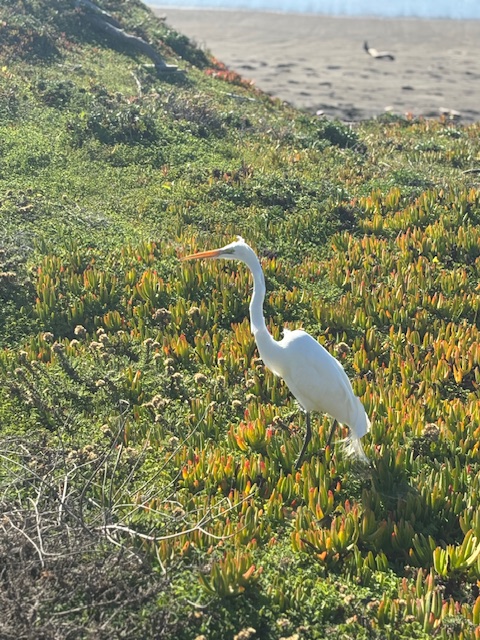
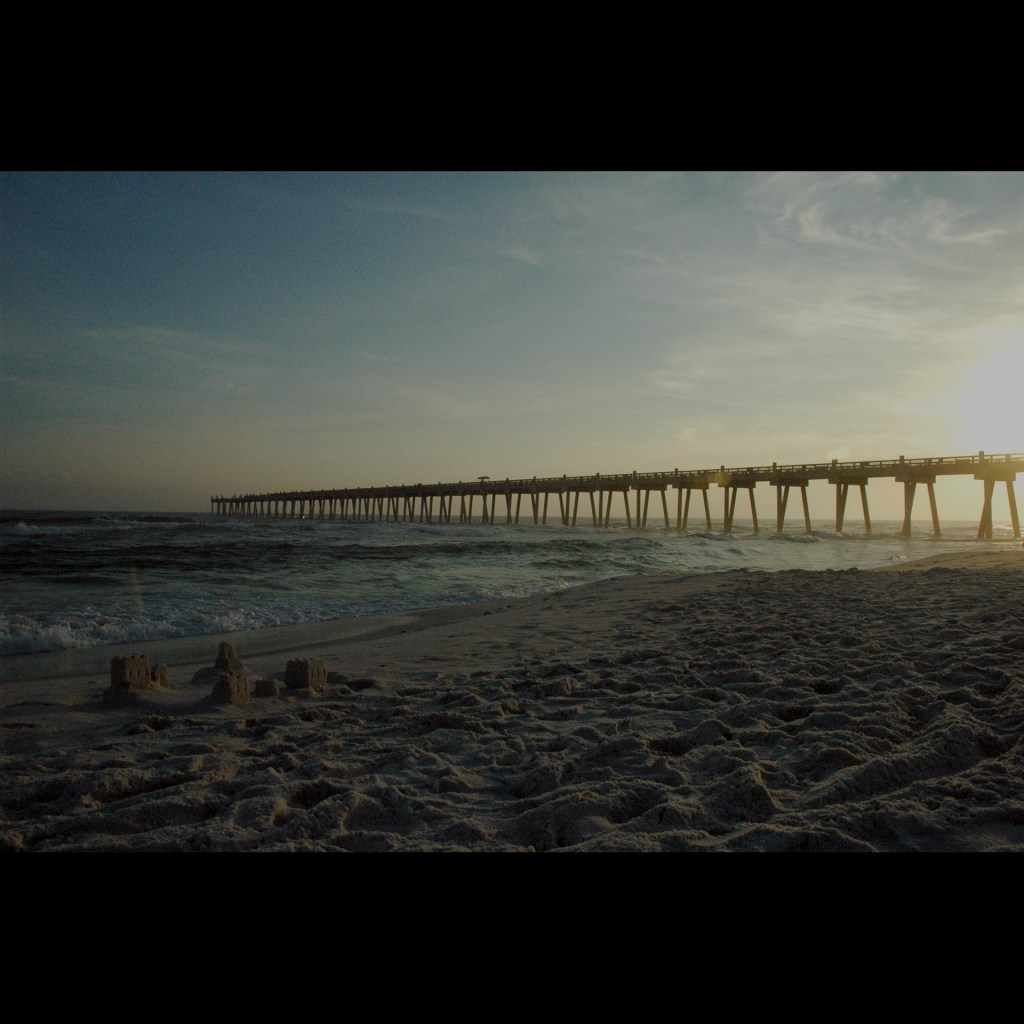
I have become one of the beachcombers, we human scavengers among the gulls and other shorebirds. Each day I walk from my campsite the half mile to the beach, then shuffle through the sand with my head down.
We search for treasures among the washed up stones and scurry like sandpipers when we venture too far toward the sea as the greedy waves pursue and try to wet our feet. We flee as best we can, but inevitably we stray back down, drawn by the clickety clack of stones rolling over stones as the waves recede and drag them back and forth, back and forth, each new push and pull changing the nature of the beach, revealing new finds and hiding others.
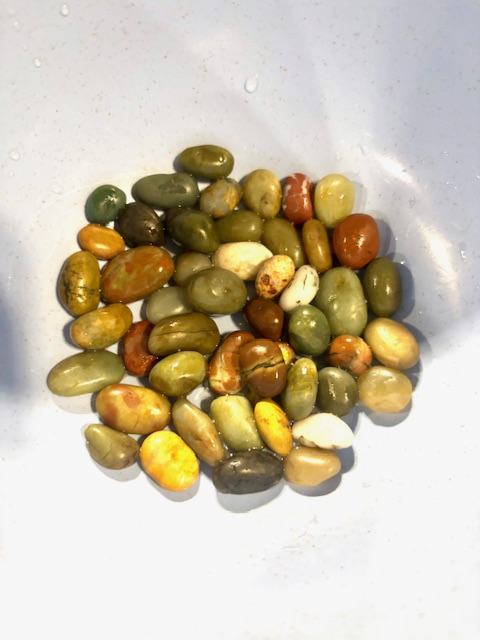
I’ve decided to search for what I’m calling jelly bean stones today. Specifically, Jelly Belly Jelly Beans, those multi-colored, sometimes freckled, unexpected flavorful little beans: Tutti-Fruitti, Pina Colada, Top Banana, Strawberry Cheesecake, and so many more. They are here among the stones, but I’ve not yet developed the eye for it, like some of these humpbacked prowlers. The professionals have bags for the task, while we amateurs fill our pockets, drop the beans in among the keys and the phone.
“What are you looking for,” I ask a woman hefting a cloth grocery bag, one of those free ones from some promotion or another that we always forget to bring when we go to the store. “Pretty rocks,” she says.
“Me too. I’m looking for ones that look like jelly beans,” I say. “I want to have them out in a candy dish at my home, in the hopes that someone takes a handful and breaks their teeth on them. My niece is a newly minted dentist and could use the business.”
Another woman searches for sea glass: perhaps the remnants of some ages ago message floating at sea that wrecked before reaching a destination, but more likely just the shattered remains of old glass soda bottles, or bottles of booze discarded into the ocean, a long-since drowned good time, the dangerous edges now worn down and polished to a translucent, beautiful stone—garbage transformed by the earth into the beauty inherent in all things if you look at them in just the right way.
“What do you do with it?” I ask.
“I trade it with my grandsons,” she says. “They love it.”
“And what do they trade?”
“Oh, trinkets and whatever they think is worth something to me. I don’t care, I just love it when we get together.”
I search now for sea glass and think about my grandmas, who always had bowls of candy. Lemon drops and sour cherries. Root beer barrels.
“A bowl of sea glass would complement my stone jelly beans nicely,” I think.
Another collector searches for moonstones. Down the road near Cambria, CA, is Moonstone Beach, named for the white, translucent stones that graced the beach in such quantities in the late 1800s that it seemed to mirror the moon’s glow and was given its name. But tens of thousands of tourists collected them, and construction companies used them for aggregate, and now the moonstones are few and far between and the beach is dark at night.
I search now for moonstones. Which reminds me about Sedona, AZ. I passed through on my way, just drove through it, but it was one of the most picturesque towns I’ve ever seen. I knew instantly that I’ll be back here someday for a longer stay, but wonder why it took me so long. Sedona has a population of around 10,000 but gets 3 million visitors per year. On a slow day, that means the population roughly doubles. During the heavy tourism season, I imagine it sometimes swells many times that.
Sedona is situated in the Verde Valley, an oasis of green (there are even vineyards here) in the dry desert encompassing half-a-dozen or more towns, including Cottonwood, where I stay the night at an RV park. It feels like this place is a secret someone has kept from me. The valley is like something sprung from a too-perfect postcard. And while some towns sit deep in the valley, others climb the mountains as you leave, the roads twisting through wilderness to reveal towns like Jerome, balanced at 5,000 feet on the mountainside with narrow brick and stone streets. Is this where the West was won? Why weren’t we losers told?
On the edge of Sedona I stop to visit a so-called vortex—believed by some to be places where the earth is especially alive with energy. People sometimes report feeling inspired, uplifted, or recharged after visiting one, and Sedona claims more of them than anywhere in the world.
And so I drive to the edge of town up a hillside among the red rocks and hike and then I’m there, I’m in the vortex, and I feel nothing. Or rather, I should say, I feel something—I see a beautiful view, the town of Sedona below, ringed all around by red and orange and yellow stony hills and buttes, and I’m outside and it’s gorgeous, the sun is beating down and so I feel that feeling I always feel when I step into something nature put together so incredibly—inspired, energized, uplifted, recharged. I knew before seeing a vortex that surely they were sites of particular beauty, or why would someone have named them magic? Today, all throughout Sedona, you might buy some of that magic from within the endless shops with names like Twisted Alchemist, Crystal Magic, Soul Stone Vibrations—selling stones with healing powers and other new age cures.
I am not prejudiced toward nor entirely skeptical of these healing crystal people, these post-modern yogis and energy dealers—despite science having so far found nothing to indicate any different quality or quantity of energy within a vortex. The few of these believers I’ve met have been so compellingly nice, so incredibly kind, as to be potentially on entirely other wavelengths of the human experience from me, whose heart is stone, and so I remain dubious but agnostic about the whole thing. Except to say that perhaps we aren’t getting outside enough, because vortexes, I have found, are everywhere.









Leave a comment