
I’m currently at Cholla Campground, Tonto National Forest—billed as one of the largest solar-powered campgrounds in the United States. Since they don’t have electricity at the campsites, I’m not exactly sure what that means. All the bathroom lights are solar powered, I guess, and they have hot showers. But the extent of the solar appears to be bathroom rooftop solar (better than no solar, considering this generally burning hot location). There is, however, a campground host (a retired machinist) who drives around an old riding lawn mower (blade removed) he converted to run on solar power. He is, as you might expect, totally badass.
This campground in Arizona is about 80 miles south of where I was last weekend. I ended up here after a snowstorm prevented me from heading east and north—back to Minnesota.
This area is classic semi-arid desert southwest, with mesquite trees, shrubs whose names are unknown to me no matter how many times I look them up, the iconic saguaro (I learned last year that it is pronounced suh·waa·row) cacti and, of course, cholla cacti. The campground is right on the edge of the largest lake in Arizona, Roosevelt Lake, so naturally when I arrived here on Friday evening I bought a fishing license in order to, so far, fish every single evening without so much as a single bite (I’m nothing if not persistent when it comes to being bad at fishing). But the temps have been perfect, the sunsets beautiful, the soft light drizzling down each evening to blanket the rust covered Sierra Ancha Mountains that border the lake.
Last year around this time I camped just 30 miles south of here at Tortilla Flats; still, Google Maps clocks that drive at more than 90 minutes for those 30 miles. And Google Maps is assuming that you’re driving an average vehicle, not a truck towing a camper (I learned this the hard way on a different road). And so that road is probably very, very bad. Which is how you know it’s true when they call it one of the most scenic and historic roads in America—the Apache Trail Scenic Byway.
A quick look on the US Forest Service site passive-aggressively confirms this by preemptively scolding the incautious: “The scenic byway (with numerous sharp curves and narrow stretches of road) is safe to all but the reckless driver. Pulling trailers of any type over this road is strongly discouraged.” Unfortunately, this road was closed last year, and I won’t have time to drive it this year, so for now it will remain untraversed to this sometimes reckless driver.
The sun is a giant ball that throws free energy at its little planet friends
I think the last time I was connected to the electrical grid was on Jan. 8. Otherwise, I’ve been successfully running all my electronics on solar power, and it seems like I’ve been blessed with sunny days 90 percent of the time I’ve been camping. On work days, I run my laptop and my Starlink (and charge my phone, play the radio, etc.) all day long and my camper battery pack (three 100 amp lithium batteries) rarely dips below 100 percent, and then only on exceptionally cloudy days. Which is to say that I’ve been producing more power than I can use for about 60 of the last nearly 70 days. If I were hooked up to the grid, most states would actually pay me for that excess power. In the evenings, I’ll run the lights and watch a streaming service and the batteries will run down to perhaps 85 percent, and by the time I wake up in the morning, they’re back to 100.
Another benefit of my setup is that, while I have a generator for backup power (can’t risk no power when working remotely), I haven’t had to use it, which means I haven’t had to listen to it run for hours each day. I have 400 watts of solar glued to my RV roof (where it can’t be stolen), plus a 100 watt solar “suitcase” that I can position directionally if I need a boost on a cloudy day.
Unfortunately, not everyone is tuned into solar yet, and so lots of people are running generators in the mornings and evenings, sometimes for hours, which kind of defeats the purpose of getting some peace and quiet while camping and annoys the shit out of everyone. I think it’s just a knowledge hurdle. It takes a little work, a little self-education, and a friend named Tony to really get your solar power setup humming. But even folks with generators would benefit from knowing that if you don’t have a big enough battery to collect and store the power your generator is producing, you’ll just blow through that battery again and again and waste the output of your generator.
I’m not a doomsday prepper, but reading the news lately, it actually gives me a lot of comfort to know that I could disappear at any time into the wild (at least until our public lands are sold off to the highest bidder sometime later this year) and live comfortably as the civil war, or the war with our belligerent and aggressive Canadian neighbors to the north, rages. I just need to catch a few more fish if I plan to eat.
This and the fact that the EPA is being totally gutted and climate change denial is en vogue again has me thinking about getting solar for my home without wheels. After all, there are plenty of sunny days in Minnesota, and while the solar might not pay you like it does in the southwest, you will break even eventually.
It’s funny, but I remember in 8th grade science class learning about earth as a closed (matter, not energy) system, but the people now leading the EPA must have quit school before 8th grade.
So here’s an experiment—and it’s important that you only try this if you’re a climate change denier. Go out into your garage and close the garage door. Start your car and let it run. Assuming that your garage is not airtight, some of the carbon being emitted from the burning of gasoline will escape your garage into the atmosphere in much the same way that greenhouse gasses will—to a small extent—escape our atmosphere. But for the most part, when it comes to matter—and gasses are matter—carbon is no Houdini. Which is exactly who you’ll need to be if you’re going to get out of your garage alive. In the meantime, here’s a safer experiment to try.
Tomorrow I head home.
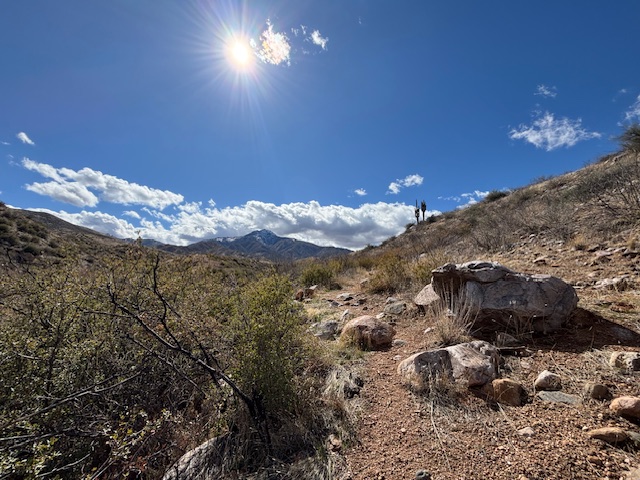
Hiking in Tonto National Forest 
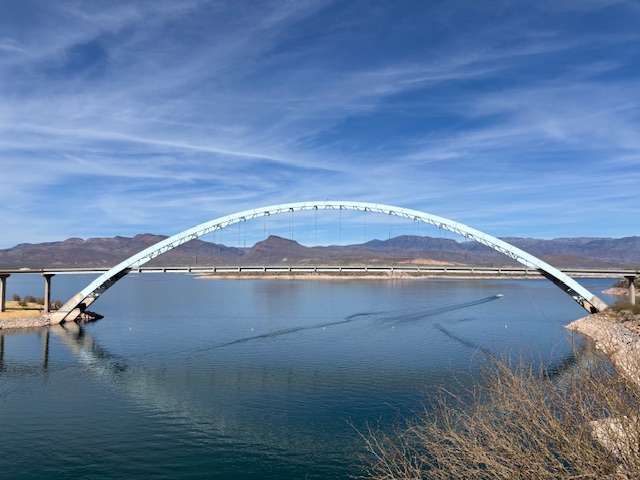
The Theodore Roosevelt Lake Bridge a few miles from my campsite is the longest two-lane, single-span, steel-arch bridge in North America. 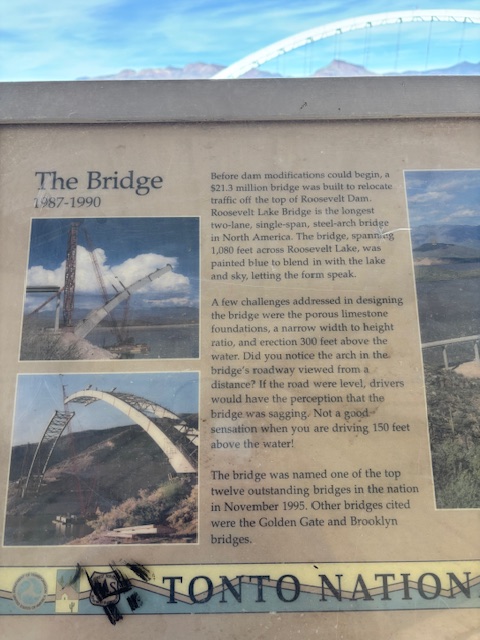
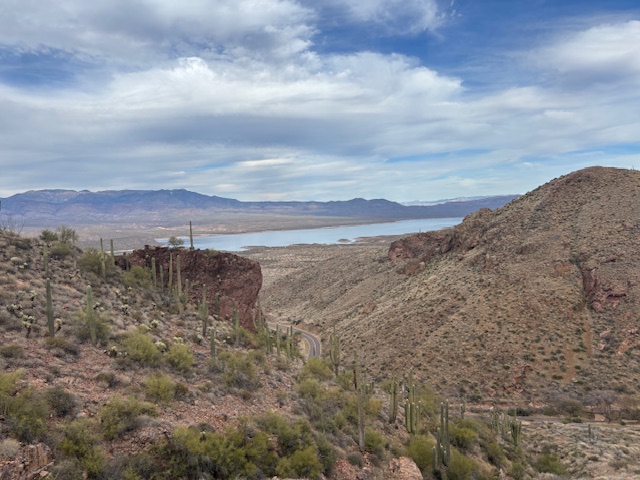
View from Tonto National Monument 
Tonto National Monument, occupied from 1300-1450 by the Salado peoples. It is a steep hike up. They must have been in great shape. 
Nice paved path to Tonto National Monument 
No water!!! Amazing. 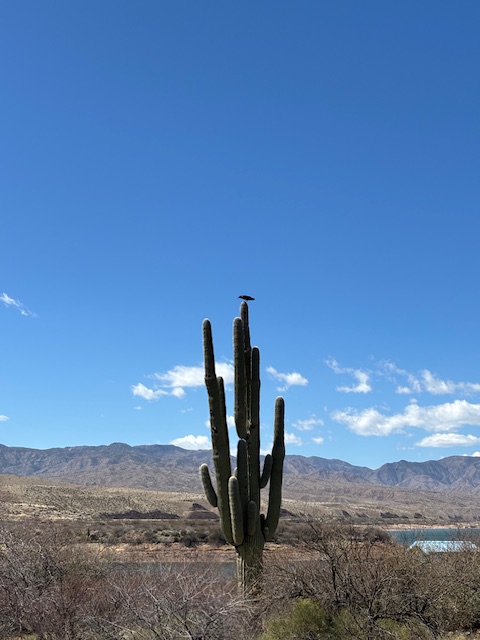
Quote the Raven, “suh·waa·row” 
A lady showing me a “pack rat’s” nest. I didn’t know they were a real thing. It gathered sticks, tin, a capri sun bag, a plastic egg, and lots of poop. It will climb up into your engine and eat your brake lines on cold nights.




Leave a comment