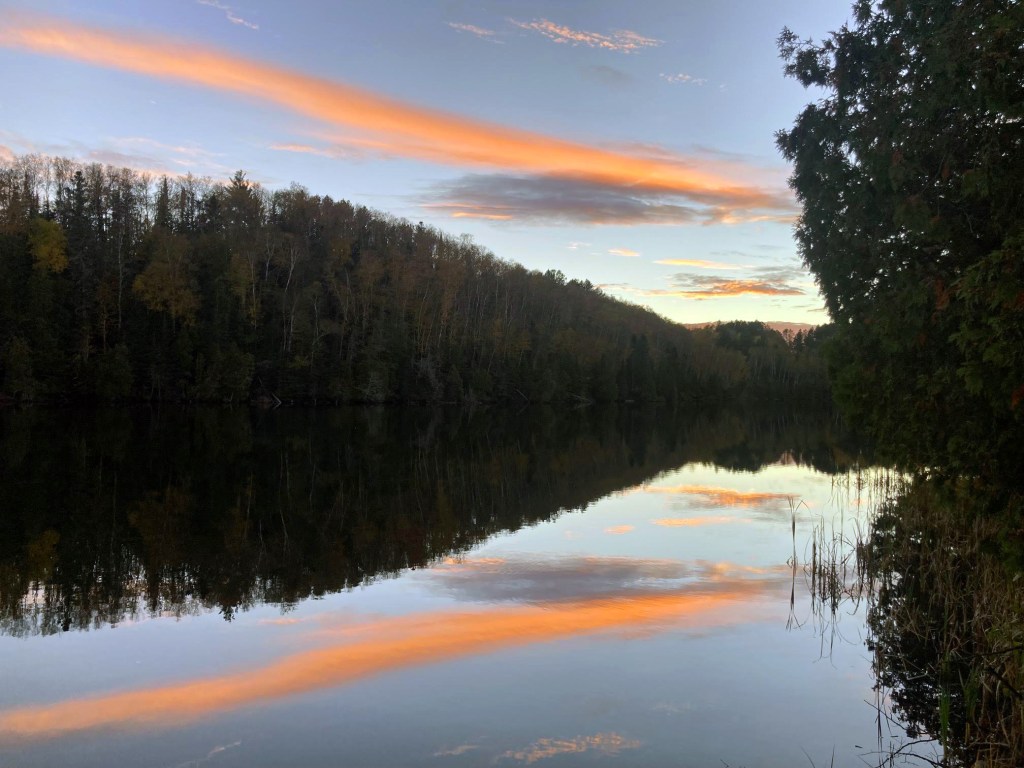
I’d originally written the following poem as a paragraph, with all its commas and periods and other detritus. It was about my time camping in Northern Minnesota a year or two ago in the fall alongside a quiet lake with just three camping spots (no water, no electricity) down a long and twisting gravel road an hour’s drive into the woods.
Since October, I’ve been working to collect writings to compile into a book. Mostly these are writings from the past few years, but some reach as far back as two decades. Still, after all, it will be a short book. I have not been prolific.
There will be some poetry, lots of essays, some interludes and absurdities (as I’m calling them), odds and ends. I’m thinking of calling the book, “Poetry and Pudding.” I’m sure it will be a bestseller.
So, I’ve been re-reading a lot of writings lately, putting them into digital piles of “maybe” and “no” in round 1, then “yes,” “no,” and “maybe” in round 2, then “yes” and “yes, but needs revision” in round 3, and ultimately I’ll end up with a final round, the pile of yeses, a much shorter stack than I suspected I’d have when I began. I’m thinking of calling the book, “A Pile of Yeses.”
I’m not sure if this former paragraph, now a poem, will make it into the yes pile, but the last sentence has stuck with me since I wrote it, about the wind feeling like a beginning, and sometimes, an end. If you’ve been outside when a front moves in, at the start of a storm there’s an uncertainty about what’s coming, a simultaneous excitement and foreboding, depending on how serious it might be and whether you’ve seen a weather report and know what to expect.
These days, with our weather alerts and apps, most of us know what to expect with the weather, and so there’s something lost, I think, between the certainty and uncertainty. Meanwhile, in the rest of our lives, it’s hard if not impossible to ever know what to expect, and about the time you think you do know, you’re proven wrong yet again. But then, the weatherman never bats 100 either.
The next time the wind picks up, step outside and sit with it if it’s not too much. See whether it is something that you can simply turn around and close a door on, or if instead it begins to stir inside of you as much as out.
This poem was a paragraph until it wasn’t, but maybe there’s room for ambiguity, even in this.
Early autumn, lakeside in Northern Minnesota
In the fall when the leaves turn and loosen their grip
the wind takes them
a breeze or a gust at a time
By a lakeside in Northern Minnesota
golden hearts of aspens
drift to the water’s edge
those early departers scatter to the ground
sink like wishful coins into the lakebed
fade into the muck
Trees along the nearby trails sway and creak
lean against each other like drunken pals late in the night
until someday one falls down
while the other waits its turn
And when the wind picks up suddenly
sometimes it feels to me like the end
and sometimes it feels like the beginning
But of course, it is both







Leave a reply to Anonymous Cancel reply